Phase 3: Incremental Translation
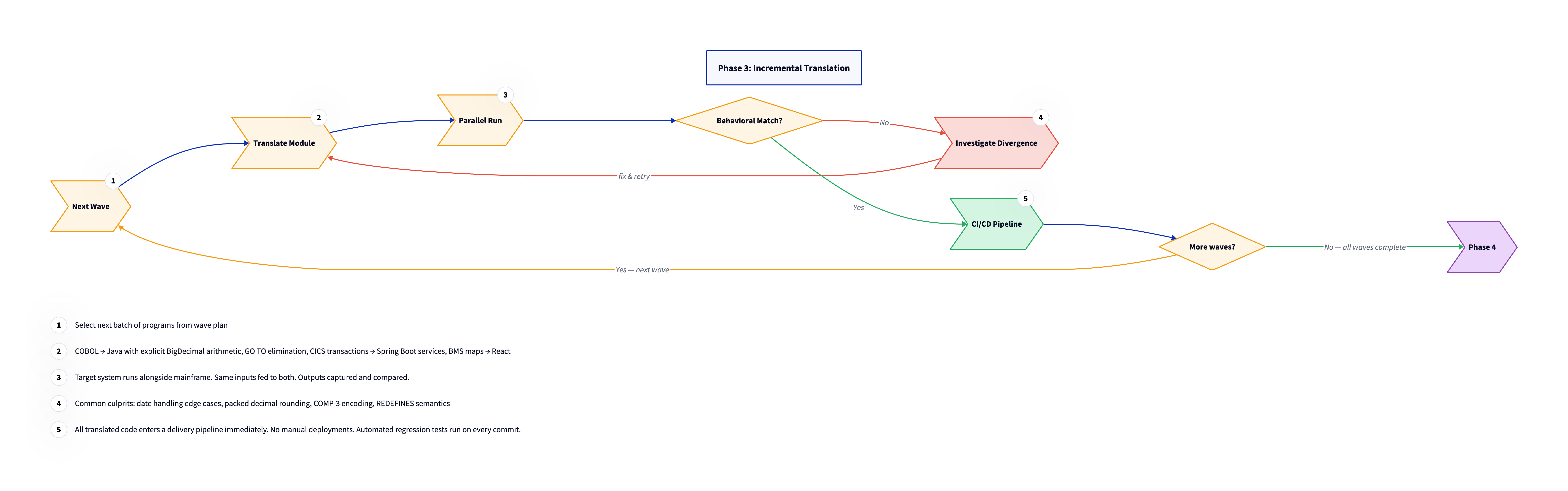
Phase 3 is where the migration actually happens, but it happens slowly and carefully. Translation proceeds one wave at a time. Each wave must pass parallel-run validation before the next wave starts. The goal is never to be in a position where the mainframe is partially migrated and the new system is only partially trusted. Every wave either works or it does not, and if it does not, it goes back to translation before anything downstream moves forward. The discipline here is sequential by design. Skipping parallel validation to move faster is how migrations fail. The mainframe is the source of truth until a wave has proven correctness in production. That is not a conservative posture; it is the only posture that allows the business to keep running while the migration happens.
COMP-3 (packed decimal). A binary numeric storage format used in COBOL for financial calculations. Two decimal digits are packed into each byte, with the last half-byte holding the sign. It avoids the rounding errors of floating-point arithmetic. In TypeScript, COMP-3 fields must be handled using a decimal library (Decimal.js or similar), not native number types. Programs that perform financial calculations will produce incorrect results if this distinction is ignored.
GO TO. A branching statement in COBOL that jumps execution to a labelled paragraph. Programs written before structured programming became standard often use GO TO extensively to implement loops, error handling, and conditional logic. GO TO elimination is the process of converting those branching patterns into structured control flow (loops, conditionals, functions). It is one of the harder parts of producing readable translated code.
Translate each module
COBOL programs are translated using a hybrid approach — the same approach used in the CardDemo spike. Mechanical transformation handles the structural elements: copybook fields become ORM entity properties, CALL chains become service method calls, and file I/O becomes repository queries. LLM assistance handles the idiomatic refactoring: restructuring large procedural blocks into service methods, generating inline documentation from the Phase 1 summaries, and renaming things to match the conventions of the target codebase.
If the estate also includes PL/I or Assembler utility programs, the same pipeline applies. The AST shape differs but the comprehension-then-translate pattern is identical. NATURAL is a distinct case — its database verbs are first-class language constructs rather than separate SQL blocks, and no public open-source parser exists. The translation methodology is the same; only the parsing tooling at the start of Phase 1 differs. See the Resources section for the current state of NATURAL/ADABAS tooling. Four failure modes require specific attention during translation:
- COMP-3 packed decimal fields must become Decimal.js or an equivalent arbitrary-precision library, not native JavaScript floats. Financial math with floats fails silently in ways that are difficult to detect in testing and catastrophic in production.
- GO TO statements must be eliminated through control flow analysis, not mechanically substituted. A mechanical substitution produces label-jumping TypeScript that is as unmaintainable as the original COBOL. Programs with 50 or more GO TO statements, like COACTUPC, require a human specialist to restructure the control flow properly.
- CICS transaction semantics must be mapped to service-layer patterns in the target framework (Express, Fastify, NestJS, Spring, or whatever the client uses). A CICS READ is not just a database read. It operates within a CICS transaction context with error handling, commarea passing, and implicit program termination behavior. Each CICS command has a target equivalent, but the mapping requires understanding what the command does in context, not just what it is called.
- BMS screen maps become React components. The mapping from BMS field definitions to React form inputs is largely mechanical, but the event handling and validation logic requires review because BMS validation rules are often embedded in the COBOL program logic rather than in the screen map itself. The translation of AWS CardDemo validated these failure modes directly. An independent AI review of the NestJS translation of 44 CardDemo programs surfaced three recurring patterns: field name drift, where translated code references COBOL-flavored property names that do not match the TypeORM entity definitions; parseFloat used on financial fields despite a project-wide Decimal.js convention; and business logic divergence in accumulation loops, where COBOL accumulates values across a record set before writing once but the translation writes on each iteration. All three are classes of issue that compile-time type checking partially catches and that parallel-run validation surfaces completely. The full translation is on the migration/typescript branch.
Parallel run (shadow mode testing). Running the translated program alongside the original mainframe program in production, feeding both the same inputs and comparing outputs. It is the safest way to validate that translation is behaviorally correct before traffic is cut over. The mainframe remains the authoritative system until the parallel run passes.
Run in parallel
Once a wave is translated, the replacement service runs in parallel with the mainframe. The same production inputs are fed to both systems. A reconciliation service captures outputs from both and compares them field by field. Divergence triggers an investigation before any further work proceeds. The edge cases that cause divergence most often are date handling, packed decimal rounding, and COMP-3 field encoding. Mainframe date formats and epoch assumptions differ from JavaScript in subtle ways that standard test cases often do not cover. The COBOL ROUNDED option and JavaScript's rounding behavior differ enough to produce off-by-one errors in financial calculations. COMP-3 packed decimal byte semantics must be explicitly handled at every data boundary where the systems exchange values. None of these are exotic problems, but all of them require explicit test coverage to catch.
CI/CD (Continuous Integration / Continuous Delivery). An automated pipeline that builds, tests, and prepares code for deployment on every commit. In this migration, CI/CD ensures that regression tests from Phase 2 run automatically on every translated wave, and that regressions introduced by later waves are caught before they reach production.
Two migration tracks
Not all mainframe logic is behind an API. Most estates include both API-accessible programs and terminal-facing programs, and each requires a different parallel run pattern. API-replacement flows are the straightforward case. The mainframe program is called through an integration layer (MuleSoft, IBM API Connect, or equivalent). The replacement service is deployed and the integration layer is configured to call both the mainframe and the new service, logging both responses. A reconciliation service compares outputs field by field. When they match consistently, the integration layer is reconfigured to route exclusively to the new service. Users and consumer applications see no change at any point in this process.
Green screen terminal workflows require a different approach. Users access these programs via 3270 terminal sessions directly against the CICS application. There is no API surface to route traffic through. Parallel run here means running scripted test scenarios against the CICS terminal session using a 3270 automation tool, and comparing those outputs against the replacement web application running the same scenarios. The web application must be functionally complete before parallel validation can happen. Terminal sessions cannot be decommissioned until the web application has been accepted by the people who use it, which requires training and a transition period.
3270 / TN3270. The terminal protocol used to connect to IBM mainframe CICS applications. Mainframe green screen sessions run over TN3270. Unlike HTTP, there is no way to route TN3270 traffic between systems; parallel run for green screen apps requires a scripted test harness rather than live traffic splitting.
CI/CD from day one
All translated code enters a delivery pipeline immediately after it passes parallel-run validation. There are no manual deployments. The regression tests from Phase 2 run on every commit. This is not optional. Without a CI/CD gate, regressions introduced by later waves can go undetected until they surface in production, at which point the cost of finding and fixing them is much higher than it would have been at commit time. The pipeline also provides the audit trail that compliance teams need: every change is traceable from commit to deployment, every test run is logged, and every deployment has an approval record. For regulated industries, that audit trail is often a regulatory requirement, not just an engineering preference.